Hands-on chart
Laguna Esmeralda Ushuaia summer, and when else to go
Twelve months on the trail
Laguna Esmeralda month by month
Choose a month to see the daylight and how the trail changes.
Sunset
Jan
- Sunset is around 22:03
Midsummer: the longest days of the year; start early and carry a warm layer.1
Apr
- Sunset is around 18:45
Autumn colour in lenga and ñire; from autumn, enter the trail before noon.17,7
Daylight is worked out for the 15th of each month at Laguna Esmeralda, on Argentina time. Season notes come from InFueTur and Ushuaia's tourism office, not from a weather station: none lies close enough to the trail.
A Laguna Esmeralda Ushuaia summer means long light and a busy trail; autumn brings red forest, winter brings snow. Here is how each season changes the walk.
Editorial team, lagunaesmeraldatrek.quest · Updated November 9, 2026 · 7 min reading time
Key facts
- Most daylightSummer starts on December 21, with up to 18 hours of light.1
- ColourForests turn from late March, by the provincial board's count.2
- SnowHeaviest in July and August; snowfall is possible until September.3,4
- MildestSummer averages 10 to 15 °C on the island.5
- Trail cut-offNo later than 3:00 PM from spring to summer; by noon in the cold months.6,7
Summer: long light and a busy path
A Laguna Esmeralda Ushuaia summer starts on December 21, when the austral summer begins and the island gets up to 18 hours of daylight.1 InFueTur gives sunrise at 3:30 or 4:00 AM and sunset after 10:00 PM in this season.8 Ushuaia's tourism office describes the same thing as almost 18 hours of broad daylight.9 For a walk of 4 to 5 hours, that light is the main advantage summer offers.10
Summer is also the gentlest season for temperature, though gentle is relative at this latitude. The provincial board puts the summer average between 10 and 15 °C, while the city's own figure is an average of 9.6 °C.5,11 Days rarely climb past 25 °C.12 At the lagoon, with wind coming down from the glacier, it can feel colder than in town, so bring a warm layer even in January. Gloves and a hat weigh little and are often the difference between enjoying lunch at the shore and hurrying back down after a few minutes.
The city calls summer the time to discover these mountains on foot, with their lagoons, peat bogs, meltwater streams and glaciers.13 That is also why the trail is busy: the province notes a heavy flow of hikers through the year.14 The last entry to the trail in spring and summer is 3:00 PM.6 Start early to share the forest with fewer people and to leave room for a long stop at the water.
Season by season
Light, cold and cut-off times through the year
| Season | Months | Daylight | Temperatures | Last entry |
|---|---|---|---|---|
| Summer | From December 21 | Up to 18 hours | 10 to 15 °C | 3:00 PM |
| Autumn | March to June (city) | Shortening | Below 10 °C | Noon |
| Winter | From June 21 | 7 hours | 1 to 6 °C | Noon |
| Spring | September to December | Lengthening | Windy, changeable | 3:00 PM |
Months and temperatures from InFueTur and Ushuaia's tourism office; entry times from the provincial trail page.1,5,20,22,16,26,27,28,29,30,6,7
Autumn: the forest turns red
Ask a photographer and the answer is autumn. InFueTur calls it the ideal time for photography lovers and hikers, with red, gold and green forests against cold blue water and white mountains.17 The colour comes from the native beeches: the lenga's dark green foliage turns reddish, and the ñire's leaves turn red.18,19 On the Esmeralda trail you walk through lenga for the first stretch, so the show starts at the car park.
The official sources frame the season differently, so here are both. Ushuaia's tourism office says autumn begins in March and lasts until June, with temperatures of around 6 °C.20,21 InFueTur says the trees start to change by late March and that autumn is brief, ending in May once most trees have lost their leaves and frosts become more frequent.2,15 Temperatures in this season usually stay below 10 °C.22
Practically, early autumn is the sweet spot: colour on the slopes, crisp air and still a reasonable amount of daylight. The trade-off is the clock. From autumn the province asks walkers not to enter the trail after 12:00 noon, and it warns of shorter days, sub-zero cold and ice or snow on the path.7,23 Plan a morning start and keep the afternoon for the walk back and a hot drink in town.
Winter: snow, short days and a noon start
Winter starts on June 21, and the town marks the date with music and events for its longest night.16 The average winter temperature on the island is between 1 and 6 °C, and winds from Antarctica can push polar fronts below zero.27 Ushuaia's tourism office notes that the lowest temperatures come at the end of July and the start of August, at an average of 1 °C.24 Those numbers describe the town by the sea; the trail climbs into the mountains behind it, where snow lies longer and the wind bites harder.
The heaviest snowfalls usually arrive in July and August, and there are only 7 hours of daylight in winter.3,26 The city's snow season, when the winter centres in the valleys open, lasts from June to October.31 In that world the Esmeralda walk changes character: snow and ice replace the summer mud, the bog freezes in parts and the lagoon can look entirely different from the green water in summer photographs.
None of that makes winter a bad time, only a different one. From autumn on, the province wants walkers ready for less light, frost and a path that may be icy or snowbound.23 Going with a guide, as both tourism offices recommend, is the sensible way to go.33,34 Our separate page on Laguna Esmeralda in winter covers the snow trek, the frozen lagoon question and the kit in detail, so this guide keeps to the comparison.
Pick your season
Which season suits your walk?
Start from what you want most out of the day.
If I want the most time on the trail
Go in summer
Summer brings up to 18 hours of daylight.1
If I want photographs of the forest
Go in early autumn
The provincial board calls autumn ideal for photographers and hikers.17
If I want snow
Go from June to October
That is the city's snow season in the valleys.31
If I hate mud
Avoid the thaw
Snow can fall until September, and spring is windy and changeable.4,30
If I want a quiet trail
Start early in any season
The province notes a heavy flow of hikers all year.14
Spring and the October question
Ushuaia's tourism office places spring from September to December, when the snow gradually disappears and the forest comes back into full view.28 It describes a pleasant season in which days begin to lengthen, with vivid sunrises and sunsets.29 Its own weather notes add that spring is mostly windy and changeable.30 On the trail that combination means snowmelt, rising streams and mud in the bog.
For Laguna Esmeralda, Ushuaia, October is spring on the calendar but still part of the snow season, which the city counts from June to October.31,28 InFueTur notes snowfall can continue until September.4 So expect leftover snow in the upper valley early in the month and deep mud lower down later on. Waterproof boots and gaiters matter more now than at any other time of year, and a pair of dry socks in the pack makes the drive back far more pleasant.
Spring has advantages too. The days grow quickly, which gives you a longer window under the 3:00 PM spring and summer cut-off.6 The city also names spring as the season when the first cruise ships reach Ushuaia, so visitor numbers start to grow.28 If you can live with mud, a fine spring morning shows the valley at its quietest and freshest, with snow still on the peaks around the lagoon.
A year in the valley
The Esmeralda calendar
December 21
Summer begins
Up to 18 hours of daylight on the island.1
Late March
Forests turn
Lenga and ñire go red and gold.2
May
Autumn ends
Most trees bare, frosts more frequent.15
June 21
Winter begins
Ushuaia marks the longest night.16
July and August
Deepest snow
The heaviest snowfalls of the year.3
September
Thaw begins
Snowfall is still possible this month.4
Weather that changes by the hour
Whatever the month, plan for change. Ushuaia's tourism office describes the local weather as almost unpredictable, even within a single day.39 InFueTur says much the same: a few hours of sunshine can turn to wind, rain or cloud with a sudden drop in temperature.32 The island has a subpolar climate, softened by the surrounding ocean, with an average temperature of 6 °C.40,25 A clear morning tells you little about the afternoon, so pack for the roughest part of the afternoon rather than for the sunny start.
Visit Argentina labels the lagoon's climate cold and dry and recommends warm clothes for very low temperatures.41,42 Treat that as a baseline for all seasons. The provincial advice on clothing is to dress in layers, with waterproof clothing and footwear as essentials against rain and snow.35,36 UV is strong here too: InFueTur recommends sunscreen above factor 30 in summer and winter.37 Sunglasses earn their place too, above all when snow lies around the lagoon and reflects the light.
Look at the forecast the night before, then once more over breakfast. A Spanish-language search for laguna esmeralda ushuaia clima will bring up local forecasts and recent hiker reports, which often say more about the state of the bog than a city forecast does. Guided tours run in most weather: our site tour runs rain or shine, which is worth knowing when you book a single available day.
Video
A summer walk to the Emerald Lagoon in Ushuaia
Matched to Travel on YouTube · Nothing is fetched until you hit play.
The weather is unstable and can change suddenly from one moment to the next, so you should bear this in mind when planning any activity
Pack for the season
Season checklist
Choosing your hour on the day
Season matters, but so does the hour you set off. The provincial hiking leaflet says an early morning start gives you more safety, and the trail cut-offs exist for the same reason.38,6,7 An early start also gives you the forest at its quietest, before the day's walkers and tour vans arrive at the car park beside the road. It also means the boggy middle section is still firm with overnight cold on frosty days, which is easier walking than the soft afternoon mud, and you have spare light if the return takes longer than planned.
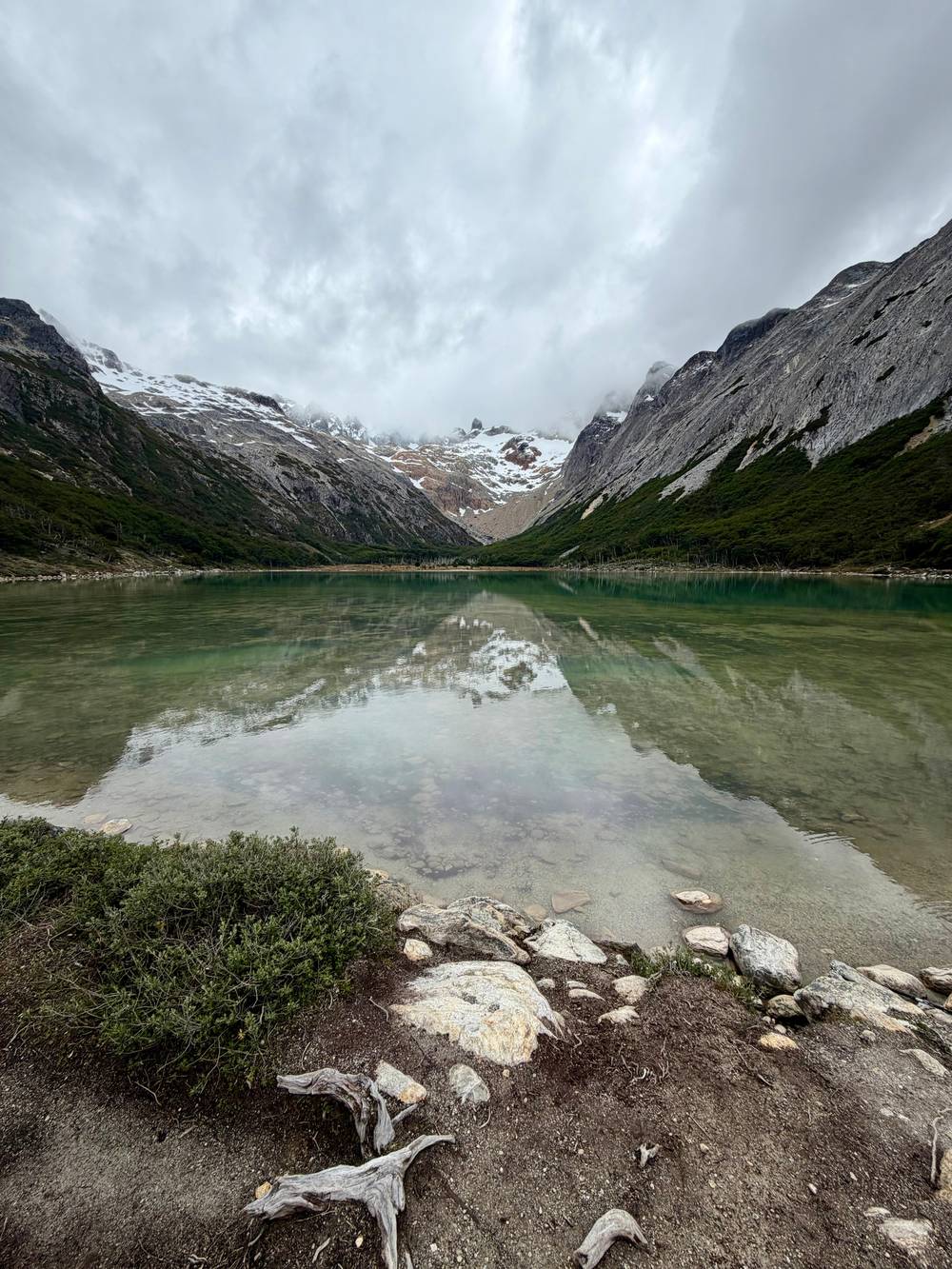
Calm mornings give a better chance of reflections. Visit Argentina describes the snow peaks mirrored in the lagoon on a still day, and wind is what breaks that mirror.43 Because the weather can change within hours, the honest advice is to go when you can, rather than wait for a perfect forecast, and to treat a calm, clear spell at the shore as a bonus. Give yourself a spare day in Ushuaia if the lagoon matters to you, so a storm on the planned date does not cancel the walk altogether.
Guided tours handle the timing for you. Our site tour collects guests from their hotels in Ushuaia and allows 2 hours of walking up, 1 hour at the lagoon and 2 hours back. That rhythm fits inside the cut-off in every season. If you walk on your own, copy it: aim to reach the lagoon by late morning in winter, and use the long summer light for a slower pace rather than a late start.
FAQ
Brief questions, brief answers.
When is the best time to hike Laguna Esmeralda?
How warm is it in summer?
When do the leaves change colour?
The provincial board says the forests start to turn at the end of summer, by late March.2
Is October a good month?
What time should I start walking?
Can I hike it in winter?
The province warns of shorter days, sub-zero temperatures and ice or snow on the trail.23
Sources
- Instituto Fueguino de Turismo (InFueTur) · The climate in Tierra del Fuego ↩
- Instituto Fueguino de Turismo (InFueTur) · The climate in Tierra del Fuego ↩
- Instituto Fueguino de Turismo (InFueTur) · The climate in Tierra del Fuego ↩
- Instituto Fueguino de Turismo (InFueTur) · The climate in Tierra del Fuego ↩
- Instituto Fueguino de Turismo (InFueTur) · The climate in Tierra del Fuego ↩
- Instituto Fueguino de Turismo (InFueTur) · Laguna Esmeralda trail ↩
- Instituto Fueguino de Turismo (InFueTur) · Laguna Esmeralda trail ↩
- Instituto Fueguino de Turismo (InFueTur) · The climate in Tierra del Fuego ↩
- Secretaría de Turismo, Municipalidad de Ushuaia · A summer to experience nature ↩
- Secretaría de Turismo, Municipalidad de Ushuaia · Laguna Esmeralda ↩
- Secretaría de Turismo, Municipalidad de Ushuaia · Useful Information for travelers ↩
- Instituto Fueguino de Turismo (InFueTur) · The climate in Tierra del Fuego ↩
- Secretaría de Turismo, Municipalidad de Ushuaia · Valley Circuit - Winter Centers ↩
- Instituto Fueguino de Turismo (InFueTur) · Laguna Esmeralda trail ↩
- Instituto Fueguino de Turismo (InFueTur) · The climate in Tierra del Fuego ↩
- Instituto Fueguino de Turismo (InFueTur) · The climate in Tierra del Fuego ↩
- Instituto Fueguino de Turismo (InFueTur) · The climate in Tierra del Fuego ↩
- Sistema de Información de Biodiversidad, Administración de Parques Nacionales · Nothofagus pumilio ↩
- Sistema de Información de Biodiversidad, Administración de Parques Nacionales · Nothofagus antarctica ↩
- Secretaría de Turismo, Municipalidad de Ushuaia · Autumn ↩
- Secretaría de Turismo, Municipalidad de Ushuaia · Autumn ↩
- Instituto Fueguino de Turismo (InFueTur) · The climate in Tierra del Fuego ↩
- Instituto Fueguino de Turismo (InFueTur) · Laguna Esmeralda trail ↩
- Secretaría de Turismo, Municipalidad de Ushuaia · Useful Information for travelers ↩
- Instituto Fueguino de Turismo (InFueTur) · The climate in Tierra del Fuego ↩
- Instituto Fueguino de Turismo (InFueTur) · The climate in Tierra del Fuego ↩
- Instituto Fueguino de Turismo (InFueTur) · The climate in Tierra del Fuego ↩
- Secretaría de Turismo, Municipalidad de Ushuaia · Spring ↩
- Secretaría de Turismo, Municipalidad de Ushuaia · Spring ↩
- Secretaría de Turismo, Municipalidad de Ushuaia · Useful Information for travelers ↩
- Secretaría de Turismo, Municipalidad de Ushuaia · The Longest Snow Season in the Southern Hemisphere ↩
- Instituto Fueguino de Turismo (InFueTur) · The climate in Tierra del Fuego ↩
- Secretaría de Turismo, Municipalidad de Ushuaia · Laguna Esmeralda ↩
- Instituto Fueguino de Turismo (InFueTur) · Laguna Esmeralda trail ↩
- Instituto Fueguino de Turismo (InFueTur) · What to wear in Tierra del Fuego ↩
- Instituto Fueguino de Turismo (InFueTur) · What to wear in Tierra del Fuego ↩
- Instituto Fueguino de Turismo (InFueTur) · What to wear in Tierra del Fuego ↩
- Instituto Fueguino de Turismo (InFueTur) · Hiking recommendations leaflet (PDF, 2023) ↩
- Secretaría de Turismo, Municipalidad de Ushuaia · Useful Information for travelers ↩
- Instituto Fueguino de Turismo (InFueTur) · The climate in Tierra del Fuego ↩
- Visit Argentina (Instituto Nacional de Promoción Turística) · Esmeralda Lagoon ↩
- Visit Argentina (Instituto Nacional de Promoción Turística) · Esmeralda Lagoon ↩
- Visit Argentina (Instituto Nacional de Promoción Turística) · Esmeralda Lagoon ↩
Read on